
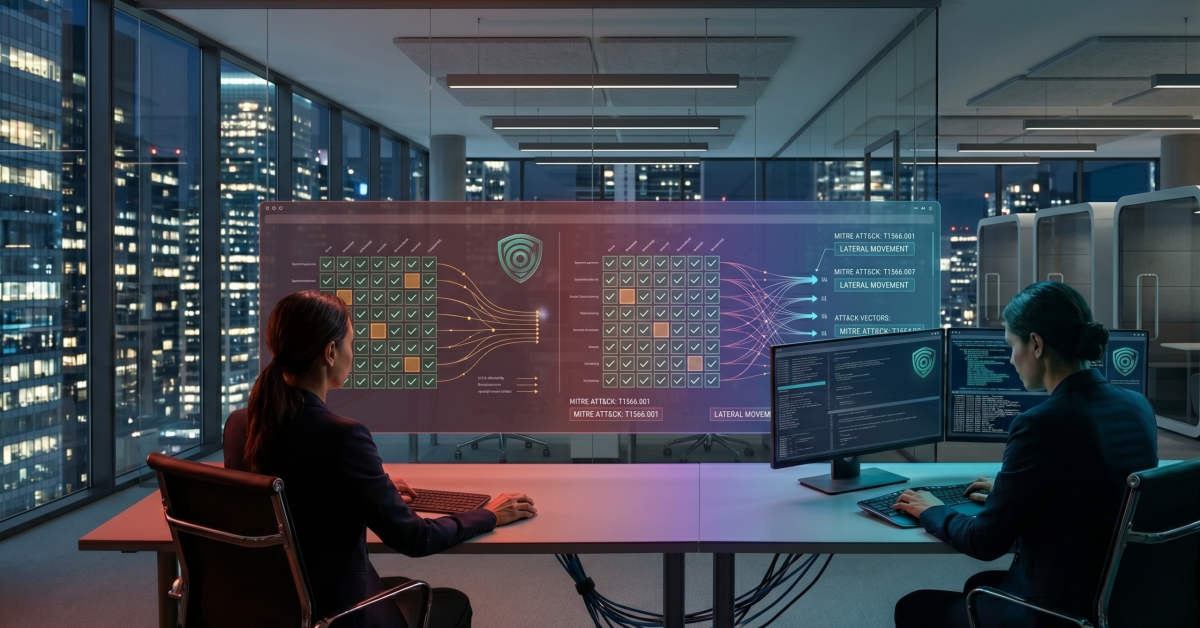
Purple teaming is a structured exercise in which a red team and a blue team work in the open, in real time, so that every simulated attack is matched against the defender’s ability to see and stop it. Where a traditional pentest produces a report and an annual red team produces a single after-action debrief, the practice produces a live detection improvement loop. For security leaders running a maturing program, that loop is what turns a static finding into a measurable change in the SOC.
This article walks through what a purple team is, how it differs from a red team exercise, what happens during an engagement, the role of MITRE ATT&CK, the outcomes a CISO can expect, and the readiness signals that suggest an organisation is ready to run one.
What Is a Purple Team?
A purple team is not a third standing team alongside red and blue. It is a working mode that brings the two together for the duration of an exercise, with a facilitator coordinating the session and capturing what each side observed.
The defining feature is collaboration: the offensive side shares what it is doing as it does it, and the defensive side shares what its tooling is seeing in return. The colour metaphor follows from the mix of red and blue. Nothing about the working mode requires new headcount. It requires a different posture.
In practice, the session is a set of agreed attack scenarios run with full transparency. The red side announces what it is about to do, executes the technique, and the blue side reports what telemetry surfaced, what alerts fired, and what was missed. The facilitator captures the gaps and turns them into tuning work the SOC can act on the same week.
How Purple Teaming Differs from a Red Team Exercise
The cleanest way to separate the two is by what each one is trying to measure.
A red team exercise measures whether a determined adversary can reach a defined objective without being caught. The blue team is not told an exercise is in progress. The result is a realistic test of the organisation’s ability to detect and respond under live conditions. For the full picture on objective-based engagements, see our earlier piece on red teaming.
A purple team exercise measures something different. It measures whether the defenders can actually see specific adversary techniques in their environment, and how quickly the team can close the gap when they cannot. The exchange is open. Both sides know the technique under test, the host it is being run against, and the time window. The point is not surprise. It is red team blue team collaboration with a shared scoreboard.
The contrast with traditional penetration testing is the iteration. A pentest is point-in-time and often compliance-driven; a purple session is built to loop. The iterative part is what gives the practice its value. A finding from a pentest sits in a report; a finding from a purple session is rerun the same day after the SOC tunes the rule, so the team can confirm the gap has actually closed.
Two further distinctions are worth keeping in mind. Red teams optimise for stealth; purple sessions optimise for clarity. Red teams produce a narrative report; purple sessions produce a list of detection deltas mapped to specific techniques.
What Happens During a Purple Team Engagement
A well-run session moves through four phases. None of them are exotic, but the discipline is in running them in sequence and in keeping the loop tight.
- Threat intelligence gathering. The team picks the threat actors and techniques most relevant to the organisation’s sector, geography, and crown-jewel systems. A bank runs different scenarios from a manufacturer. Inputs come from CTI feeds, recent incidents, and observed campaigns against peer organisations.
- Exercise design. The selected techniques are turned into an emulation plan: specific commands, specific hosts, specific user contexts, and the expected detection points along the way. The plan names what each side should be able to observe at every step.
- Simulated attack execution. The red side runs the techniques in the agreed order, narrating each step. The blue side reports in real time what the SIEM, EDR, and other telemetry surfaced, what fired, and what stayed silent. Anything that was missed becomes a candidate for tuning before the next run.
- Post-exercise review and rule tuning. The team converts each gap into a concrete change: a new detection rule, a tuned threshold, an enriched data source, or a missing log pipeline. Where possible, the same technique is re-run after the change to confirm the detection now fires.
Sessions typically run a half-day to two days, depending on scope. The shape of the deliverable is a technique-by-technique table showing what was attempted, what was detected, what tuning was applied, and what the post-tuning result was.
The Role of ATT&CK and Adversary Emulation Plans
MITRE ATT&CK gives both sides a common language. As MITRE puts it, “ATT&CK provides a common language and framework that red teams can use to emulate specific threats and plan their operations.”
For a purple team, ATT&CK does three things. It gives the offensive side a catalogue of techniques to draw from when designing scenarios. It gives the defensive side a way to describe their detection coverage in the same terms. And it gives the facilitator a map for tracking improvement across sessions: a technique that was missed in March can be re-run in June to confirm the new detection holds.
Emulation plans take this one step further. Instead of running a generic technique list, the team picks a specific threat actor that maps to the organisation’s likely adversaries and runs the chain of techniques that actor is known to use. The result is closer to a real intrusion path: initial access, persistence, credential access, lateral movement, and exfiltration, in the order an actual campaign would unfold. ATT&CK’s emulation library is a useful starting point for organisations that do not yet have their own intelligence-led plan.
Working from a named adversary plan also helps the post-exercise conversation. A board-level summary lands more cleanly when it can say “we tested our coverage against the techniques used by FIN7 and closed five of the seven gaps within the engagement window.”
Key Outcomes: From a Static Report to a Live Detection Loop
The output of this kind of engagement is qualitatively different from a pentest deliverable.
A penetration test produces a list of vulnerabilities and a remediation plan. That is valuable, and for organisations still building their offensive testing baseline, the risks and benefits of penetration testing are the right starting point. A purple team produces something more operational: a measured detection coverage map, a list of tuning changes applied during the session, and verified evidence that those changes work.
A useful way to think about this output is as exposure validation: deliberately testing whether the threats the organisation believes it can detect and contain are actually visible in its environment. That framing matters. Most organisations have detection rules they assume are working. A purple session is the lowest-friction way to find out which ones actually fire under realistic conditions and which were silently broken by a tooling change six months ago.
The concrete outcomes the team typically delivers include:
- A coverage matrix mapping tested techniques to detection results before and after tuning.
- A set of new or updated detection rules, tested in production telemetry during the session.
- Detection tuning notes for the SOC, including rule logic, thresholds, and any new data sources that need to flow.
- Recommendations for the next session, prioritised by the techniques where coverage is still weakest.
Run consistently, the practice closes a familiar gap. Adversaries keep evolving their attack TTPs, and static testing cadences let breaches go undetected for weeks or months while the next annual exercise is still on the calendar. The collaborative model is one of the more effective ways to narrow that window.
When Your Organisation Is Ready for Purple Teaming
The practice is not the right starting point for a security program. It works when several preconditions are already in place.
The clearest readiness signals are these:
- A functioning offensive testing baseline. The organisation has run penetration tests, ideally including some form of red team or red team exercises, and acted on the findings.
- A working detection stack. EDR, SIEM, or an MDR provider is in place, telemetry is flowing reliably, and someone is responsible for tuning rules.
- SOC capacity to act on findings between sessions. A purple session generates tuning work. If the SOC has no slack to apply changes, the loop breaks.
- Defined crown-jewel systems and threat priorities. The exercise design depends on knowing which techniques are most relevant to the business, not running a generic checklist.
Organisations that meet these criteria tend to get strong value from a first session within the first quarter. Those that do not are usually better served by closing the gap on the prerequisite first, whether that is finishing the rollout of a SIEM, completing an initial red team, or hiring a dedicated detection engineer.
SANS has framed the longer arc of the practice well: “As purple teaming matures as a security activity, it should integrate in Security Operations and become a continuous, highly automated, activity.” A reasonable trajectory for most organisations is one or two facilitated sessions per year, supplemented by lighter-weight internal sessions on a quarterly cadence as the SOC builds the muscle to run them itself.
How CyberGlobal Runs a Purple Team Engagement
CyberGlobal’s offensive and defensive teams run purple sessions as a structured extension of the broader penetration testing services the team delivers across enterprise and mid-market clients. Each engagement is built around an ATT&CK-aligned emulation plan tailored to the client’s sector, with detection deltas captured live and tuning changes applied alongside the client’s SOC during the session.
Similar organisations benefit most from this engagement model: security teams that already run an annual pentest, have telemetry flowing into a SIEM, and want to move beyond a one-time report into a measurable improvement cycle. The natural next step after the annual pentest is not a bigger pentest. It is a session that turns the same offensive expertise into detection coverage that the team can prove.